Language has never been as accessible as it is today. Advances in artificial intelligence have enabled real-time translation at scale, allowing individuals and organisations to communicate across borders with unprecedented ease.
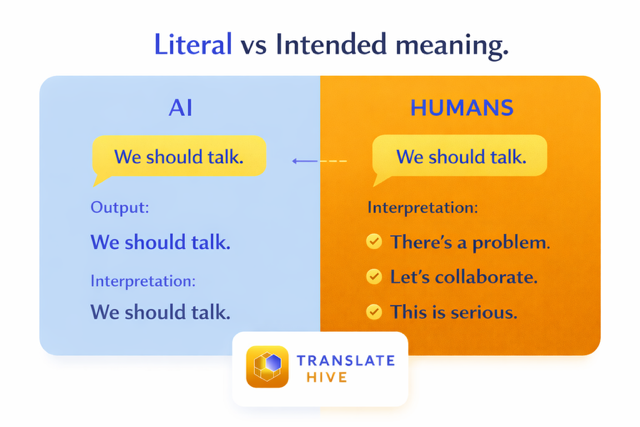
Yet for all its progress, AI still operates within a fundamental limitation: it processes language as data, not as lived experience.
This distinction becomes critical when we consider how language actually works. English, often assumed to be straightforward, is anything but. It is filled with irregularities, contradictions, and contextual shortcuts. Words can change meaning based on tone, phrases can imply the opposite of their literal interpretation, and cultural references can reshape an entire conversation.
These complexities are not exceptions, they are the norm.
AI performs exceptionally well in structured environments. It identifies patterns, applies learned models, and produces consistent output. For documentation, transactional communication, and high-volume translation, it is both efficient and effective.
However, real-world communication rarely exists in such controlled conditions.
Human interpreters operate in the space where structure breaks down. They interpret hesitation, intention, and cultural nuance. They recognise when meaning is implied rather than stated, and when tone alters interpretation. Their role is not simply to translate language, but to preserve meaning in context.
This is not to suggest that human interpretation is without limitations. It requires expertise, is inherently less scalable, and introduces variability. Conversely, AI offers consistency, speed, and cost efficiency.
The most effective approach lies in combining both.
AI provides the foundation, enabling scale and accessibility. Human expertise ensures accuracy, relevance, and contextual integrity. Together, they create a model that is both efficient and trustworthy.
As organisations increasingly operate across languages and cultures, the focus must shift from translation alone to understanding.
Because communication is not defined by the words used, but by what is ultimately understood.