Why the meaning behind the words matters in legal translation
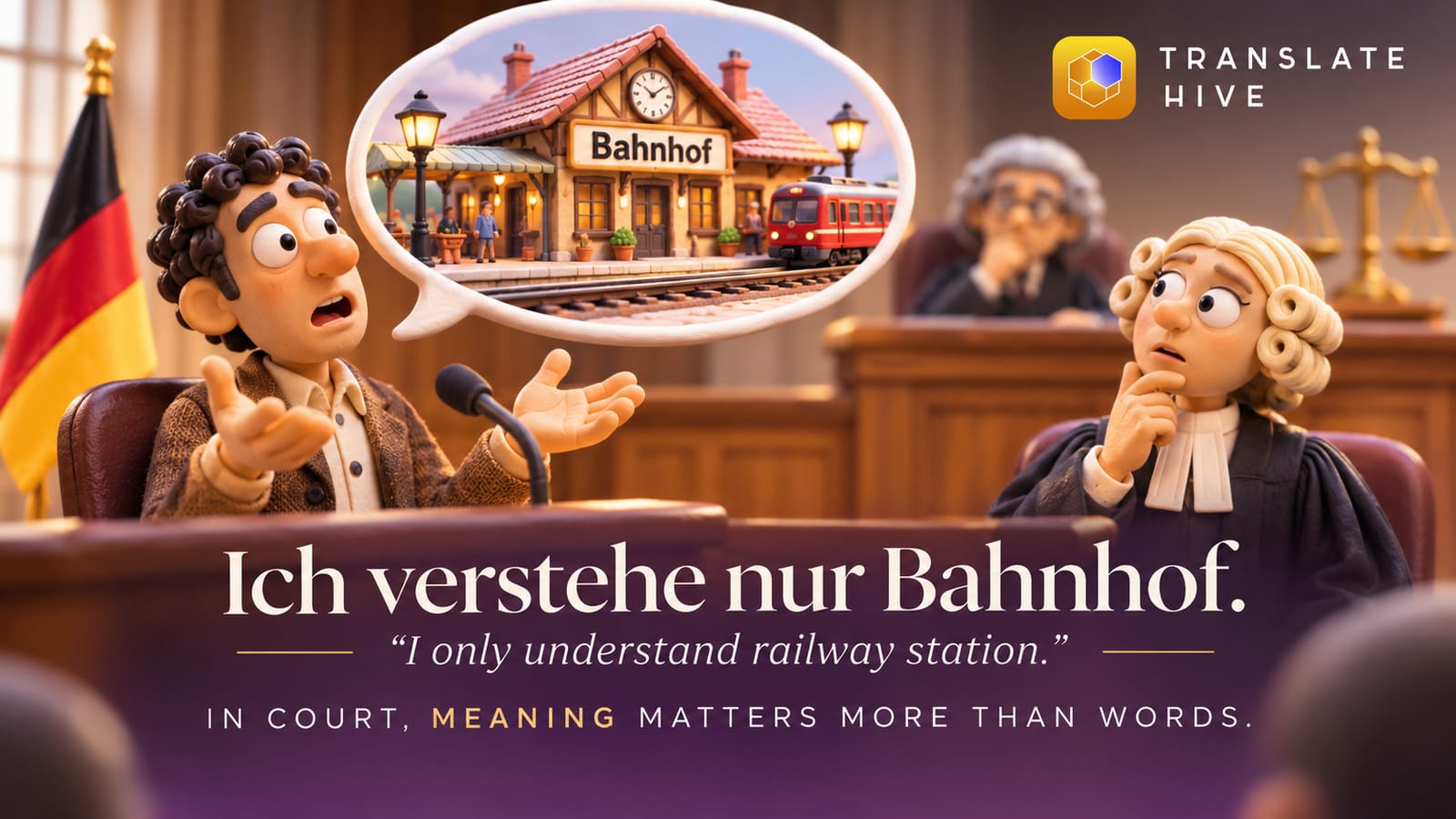
Imagine a witness in a German courtroom saying:
“Ich verstehe nur Bahnhof.”
Translated literally into English, that means:
“I only understand railway station.”
Which, of course, makes very little sense.
What the witness actually means is, “I haven't a clue what you're talking about.”
It's a simple example of an idiom, an expression whose meaning is different from the literal words used. Every language has them, and British English is particularly fond of phrases such as “pull your socks up”, “taking the mickey” and “it's all gone pear-shaped”.
They're familiar, harmless expressions in everyday conversation. But in a courtroom, misunderstanding one could have serious consequences.
When the translation is accurate, but the meaning is wrong
Consider a witness describing an altercation:
“He was giving it large, then he bottled it.”
A literal translation into another language would be virtually meaningless.
An interpreter might reasonably explain that the individual was behaving boastfully or confrontationally before losing his nerve.
But even that involves judgement. Was he being aggressive or simply showing off? Did he become frightened, or merely decide not to act?
Those distinctions may matter enormously when a solicitor is trying to establish precisely what happened, particularly if the evidence concerns threats, intimidation or someone's state of mind.
An interpreter who unintentionally exaggerates the aggression, or softens the witness's description, risks changing how that evidence is understood.
The challenge isn't simply finding the right words. It's conveying what the speaker meant without adding anything they didn't say.
Why this matters in legal proceedings
Legal interpreting is fundamentally different from translating a restaurant menu, an instruction manual or an ordinary business email.
A witness might use slang, regional expressions, sarcasm, understatement or culturally specific references. They might hesitate, contradict themselves or deliberately choose ambiguous language.
All of those things can be relevant.
Take the British expression:
“He was pulling a fast one.”
Most British speakers would recognise the suggestion of dishonesty or deception, but that doesn't automatically mean the speaker is alleging fraud, a distinction that could prove significant in a civil dispute or criminal proceeding.
Equally, if somebody says:
“He completely lost the plot.”
Do they mean he became angry? Behaved irrationally? Lost control of the situation?
The interpreter's responsibility is not to decide which interpretation best supports the case. It is to communicate the evidence as faithfully as possible, preserving the speaker's intended meaning, level of certainty and any ambiguity.
Where a phrase has no satisfactory equivalent, it may be necessary to clarify the expression rather than risk introducing a misleading interpretation.
For solicitors, this is precisely why the quality of the interpreter matters.
The problem with a translation that sounds perfectly convincing
Artificial intelligence has transformed translation. Modern systems can recognise many idioms, process large documents quickly and produce remarkably fluent results across numerous languages. For routine material, that can be extremely useful, but fluency and accuracy are not necessarily the same thing.
An AI-generated translation might read beautifully while subtly changing the strength of an allegation, removing an important hesitation or interpreting an ambiguous phrase too confidently. And because the resulting English sounds entirely natural, the error may not be immediately apparent to someone who doesn't understand the original language.
This becomes particularly important when dealing with witness statements, interviews, medical evidence, expert reports and documents intended for use in litigation. Technology undoubtedly has a place in modern translation workflows. The question is whether the level of professional oversight is appropriate to the consequences of getting something wrong.
In legal proceedings, a small linguistic error can have a disproportionately large effect.
A good interpreter understands the limits of interpretation
There is another important distinction. The role of a legal interpreter is not to improve a witness's evidence, make it more persuasive or resolve inconsistencies. If a witness is uncertain, the interpretation should reflect that uncertainty. If a statement is ambiguous, the interpreter should not quietly turn it into something definitive. And if a colloquial expression has several possible meanings, the interpreter must exercise professional judgement, recognising when clarification is appropriate.
The objective is to allow everyone involved in the proceedings to understand what was actually communicated, as faithfully and impartially as possible. That requires more than bilingual ability. It calls for linguistic competence, cultural awareness, familiarity with legal settings and an understanding of professional boundaries.
Reliable interpreting without the administrative headache
Of course, quality is only part of the challenge facing solicitors. Arranging an interpreter or translator can be surprisingly time-consuming.
Finding someone with the right language skills, confirming availability, coordinating appointments, dealing with documents, managing changes and arranging payment all take time away from fee earners and support teams. And when a hearing is approaching or an appointment changes unexpectedly, those administrative pressures can become particularly frustrating.
At Translate Hive, we understand that solicitors need two things from a language services provider.
First, confidence that the interpreter or translator appointed to their matter has the appropriate skills and understands the importance of accurate, impartial communication.
Second, a straightforward, dependable service that removes as much of the organisation and coordination as possible.
Our approach is designed around both. We coordinate interpreting and translation requirements for legal professionals, helping with suitable language professionals, bookings, arrangements and the practical details that otherwise consume valuable time.
Whether the requirement involves a client consultation, witness statement, conference, hearing or documentary translation, our aim is to make the process straightforward while maintaining the standards the legal environment demands. Because solicitors should be concentrating on the evidence, the advice and the case, not spending their afternoon chasing an interpreter.
Getting the words right is only the beginning
Language is rarely as simple as exchanging one word for another. Meaning depends on context, culture, tone and sometimes what is deliberately left unsaid. In ordinary conversation, a misunderstood idiom might produce an amusing moment of confusion.
In legal proceedings, it could affect how evidence is understood, how a witness is perceived or how an important statement is interpreted. That's why professional legal interpreting and translation remain so important, even in an age of increasingly sophisticated AI.
At Translate Hive, our job is to take the complexity of arranging language services away from solicitors, while helping ensure that nothing important gets lost in translation. And if somebody tells us they only understand railway station, we'll know exactly what they mean.
Need an interpreter or translation for a legal matter?
Contact Translate Hive to discuss your requirements. We'll help coordinate the right language support, so your team can focus on progressing the case rather than managing the booking: https://translatehive.com/contact/