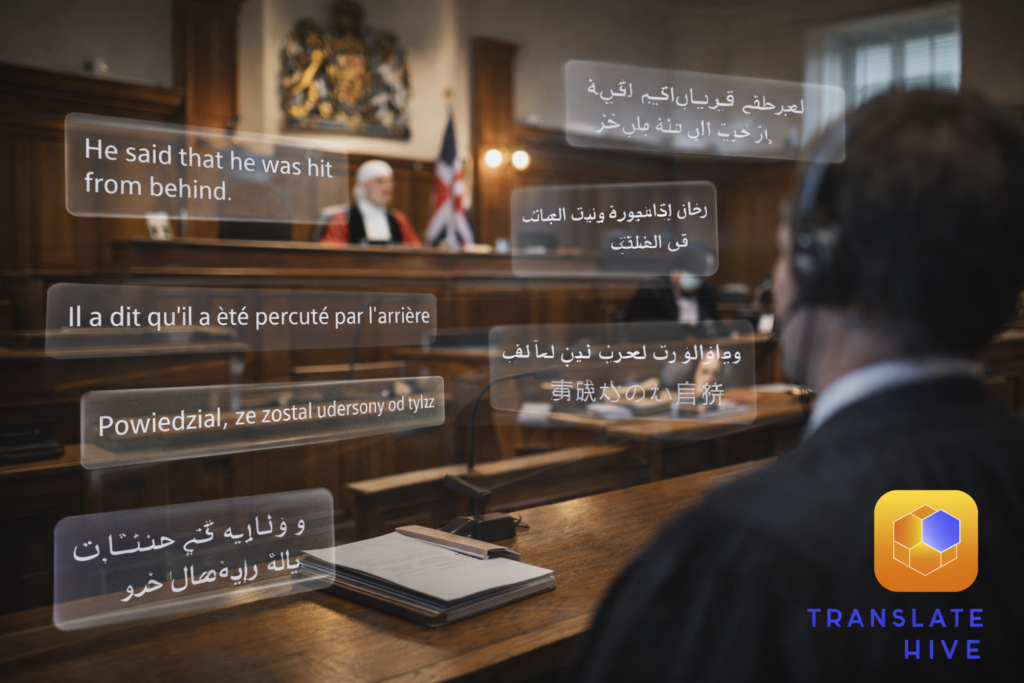
At Translate Hive, our interpreters enter courtrooms for one simple reason: to help the court understand people accurately, fairly, and without distortion. Language should never be the reason someone is misunderstood, misjudged, or disadvantaged in a legal process. Yet increasingly, that is exactly what is at risk.
Every time we step into a courtroom, tribunal, or remote hearing, we're aware that our role goes far beyond translating words. We're conveying meaning, intent, nuance, cultural context, and sometimes fear. When it's done properly, interpreting supports justice. When it's done poorly, it can quietly undermine it. The issue is not a lack of professionalism or commitment from interpreters. It's the system many of us are asked to operate within.
Doing the job properly, under growing pressure
Professional interpreters want to prepare thoroughly. We want clear instructions, sufficient context, appropriate breaks, and reliable technology. We want to understand the subject matter and the legal framework before proceedings begin.
Too often, those basics are missing. Late bookings, limited case information, poor audio quality, and unrealistic workloads have become common. Interpreters are expected to deliver complete accuracy while working in conditions that actively make that harder.
When something goes wrong, it's rarely obvious to anyone except the interpreter and the person relying on them.
Why accuracy in legal language really matters
In legal settings, small errors can have serious consequences. A slightly mistranslated phrase can change the tone of testimony. A missed nuance can affect how credible someone appears. Cultural concepts don't always map neatly from one language to another, yet they are often simplified out of necessity rather than accuracy.
When courts rely on under-qualified interpreters, or when experienced professionals leave the sector because conditions are unsustainable, the risk is not inconvenience. The risk is unfair outcomes.
This is why the recent House of Lords findings resonate so strongly with interpreters on the ground. They reflect challenges that many have been raising quietly for years.
Wanting to do the right thing, every time
Most interpreters understand the responsibility they carry. We know we are part of the justice process, even if we are not always treated that way.
We absorb emotional weight, technical complexity, and intense pressure because the stakes are real. For defendants, claimants, witnesses, and families, these moments matter.
Professional standards and personal integrity can only go so far, though. Without proper support, realistic expectations, and recognition of interpreting as a specialist legal skill, even the most experienced interpreters are being asked to operate at a disadvantage.
What a better system looks like
A better system doesn't require radical change, but it does require intent. It means recognising legal interpreting as a specialist service, not an administrative afterthought. It means engaging qualified professionals, allowing proper preparation, providing fair remuneration, and using technology that supports communication rather than obstructing it.
Above all, it means recognising that language access is fundamental to justice, not optional.
Why Translate Hive believes this matters
The UK is a multilingual society, and the legal system reflects that reality every day. As cases become more complex and diverse, the need for accurate, ethical legal interpreting only grows.
At Translate Hive, we believe interpreters should be enabled to do their jobs properly, consistently, and with confidence. Not despite the system, but because the system supports them.
If justice depends on understanding, then the people who make that understanding possible must be treated as essential. When language fails, justice doesn't just slow down — it quietly slips out of reach.